
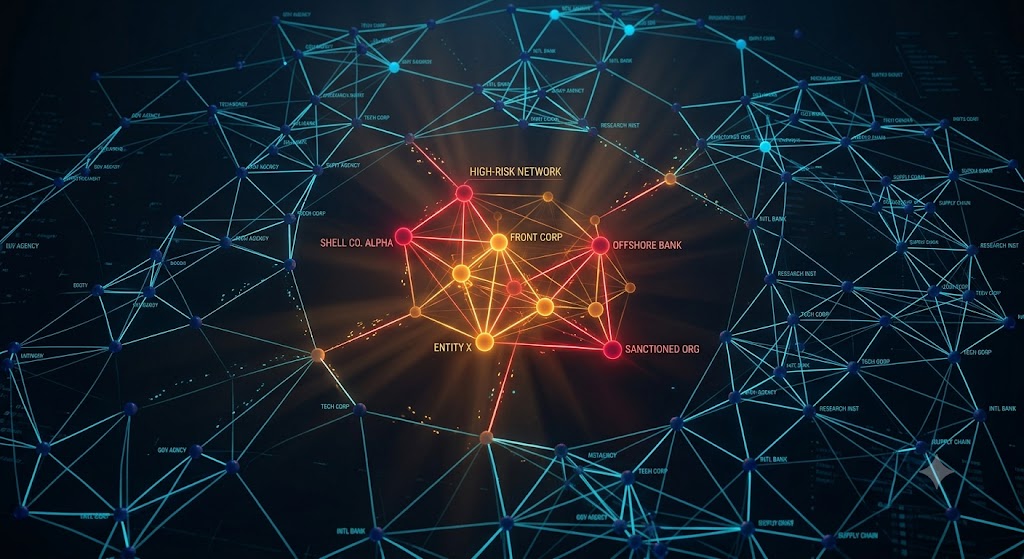
Why AI Misses the Connections That Matter (And Why We Built Something Different)

Gregor here, Co-founder and CTO of Lazlo Intelligence.

While researching the connections of Technische Universität Bergakademie Freiberg for our latest research note, I wanted to see whether a leading AI model could explain the relationship between Ulba Metallurgical Plant and Technische Universität Bergakademie Freiberg.

So I asked a simple question:

How did the Ulba Metallurgical Plant and Technische Universität Bergakademie Freiberg cooperate?

The answer surprised me.

The AI essentially responded that it couldn't find evidence of any direct cooperation.
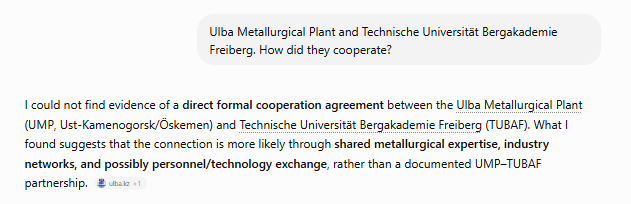
AI response: I could not find evidence of a direct formal cooperation agreement...
AI's initial response: No cooperation found.

At first glance, that sounds reasonable. Why would a Kazakh beryllium factory work with a prestigious German engineering university?

Except I knew it wasn't true. Our database had already verified a connection.

So I replied with:

I think they do in the TiBeRIUM project.

Now the AI immediately changed its answer.
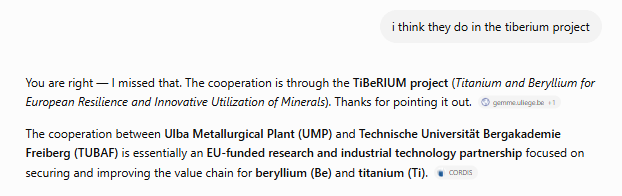
AI corrected response acknowledging TiBeRIUM project
AI's corrected response: Connection confirmed via TiBeRIUM.

It acknowledged that I was right and explained that both organisations are connected through the TiBeRIUM project.

That got me thinking.

The information clearly existed.

The AI simply didn't connect the dots until I handed it the missing piece.

This isn't really an AI problem

People often assume AI works like a search engine backed by a massive database of facts.

It doesn't.

Large language models are prediction engines. Given your question, they generate the sequence of words that is most likely to answer it based on patterns learned during training. They're remarkably good at summarising information, explaining concepts, and spotting patterns.

That's why they can struggle with questions like this.

The model may know that Ulba Metallurgical Plant is involved in one project. It may also know that TU Bergakademie Freiberg is involved in the same project. But unless those facts are particularly prominent, or your prompt nudges the model in the right direction, it may never combine them into the answer you're looking for.

In our example, the AI didn't find the relationship. It recognised it only after I suggested where to look.

For many everyday tasks, that's good enough.

But for investigations, compliance, or geopolitical risk analysis, it isn't.

A supply chain vulnerability might only become visible when you connect dozens of separate relationships across different datasets.

If your system only answers questions based on the wording of your prompt, you're relying on already knowing what to ask.

In the real world, that's rarely how investigations work, and this is exactly why we built a proprietary knowledge graph.

At Lazlo Intelligence, we don't just collect information.

We map relationships.

Every company, shareholder, government body, university, and subsidiary becomes part of a connected network.

So instead of trying to infer whether two organisations work together, our graph already knows that Ulba Metallurgical Plant and TU Bergakademie Freiberg cooperate. That relationship has already been identified, verified, and stored.
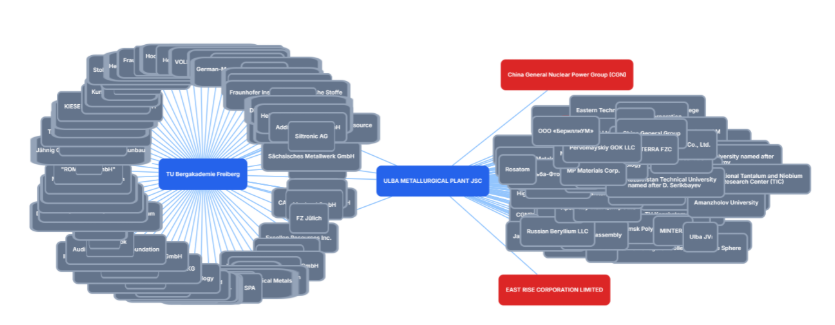
Knowledge graph visualization showing Ulba → TiBeRIUM → TU Bergakademie Freiberg connection
Our knowledge graph automatically maps the relationship.

That's the difference between generating an answer and querying structured knowledge.

AI is still part of the solution

This isn't an argument against AI.

We use AI extensively.

It's incredibly good at extracting information from reports, news articles, filings, and other unstructured sources.

But extraction is only the first step.

After entity resolution, the real value comes from organising that information into a structured network that allows hidden connections to emerge.

These connections are usually the ones that create the biggest risks.

A shared research project.

An indirect ownership chain.

A supplier several tiers down.

A sanctioned intermediary.

A university collaborating on sensitive technology.

Missing one of those relationships can lead to compliance failures, reputational damage, financial exposure, or security risks.

Finding them quickly can make all the difference.

The TiBeRIUM example is relatively simple, but it highlights a much bigger point.

AI is incredibly powerful, but it's not enough on its own.

If you want to understand complex corporate ecosystems, you need more than generated text.

You need connected knowledge.

How did the Ulba Metallurgical Plant and Technische Universität Bergakademie Freiberg cooperate?

The answer surprised me.

The AI essentially responded that it couldn't find evidence of any direct cooperation.

AI response: I could not find evidence of a direct formal cooperation agreement...
AI's initial response: No cooperation found.

At first glance, that sounds reasonable. Why would a Kazakh beryllium factory work with a prestigious German engineering university?

Except I knew it wasn't true. Our database had already verified a connection.

So I replied with:

I think they do in the TiBeRIUM project.

Now the AI immediately changed its answer.

AI corrected response acknowledging TiBeRIUM project
AI's corrected response: Connection confirmed via TiBeRIUM.

It acknowledged that I was right and explained that both organisations are connected through the TiBeRIUM project.

That got me thinking.

The information clearly existed.

The AI simply didn’t connect the dots until I handed it the missing piece.

This isn’t really an AI problem

People often assume AI works like a search engine backed by a massive database of facts.

It doesn’t.

Large language models are prediction engines. Given your question, they generate the sequence of words that is most likely to answer it based on patterns learned during training. They’re remarkably good at summarising information, explaining concepts, and spotting patterns.

That’s why they can struggle with questions like this.

The model may know that Ulba Metallurgical Plant is involved in one project. It may also know that TU Bergakademie Freiberg is involved in the same project. But unless those facts are particularly prominent, or your prompt nudges the model in the right direction, it may never combine them into the answer you're looking for.

In our example, the AI didn’t find the relationship. It recognised it only after I suggested where to look.

For many everyday tasks, that’s good enough.

But for investigations, compliance, or geopolitical risk analysis, it isn’t.

A supply chain vulnerability might only become visible when you connect dozens of separate relationships across different datasets.

If your system only answers questions based on the wording of your prompt, you’re relying on already knowing what to ask.

In the real world, that's rarely how investigations work, and this is exactly why we built a proprietary knowledge graph.

At Lazlo Intelligence, we don’t just collect information.

We map relationships.

Every company, shareholder, government body, university, and subsidiary becomes part of a connected network.

So instead of trying to infer whether two organisations work together, our graph already knows that Ulba Metallurgical Plant and TU Bergakademie Freiberg cooperate. That relationship has already been identified, verified, and stored.

Knowledge graph visualization showing Ulba → TiBeRIUM → TU Bergakademie Freiberg connection
Our knowledge graph automatically maps the relationship.

That’s the difference between generating an answer and querying structured knowledge.

AI is still part of the solution

This isn’t an argument against AI.

We use AI extensively.

It’s incredibly good at extracting information from reports, news articles, filings, and other unstructured sources.

But extraction is only the first step.

After entity resolution, the real value comes from organising that information into a structured network that allows hidden connections to emerge.

These connections are usually the ones that create the biggest risks.

A shared research project.

An indirect ownership chain.

A supplier several tiers down.

A sanctioned intermediary.

A university collaborating on sensitive technology.

Missing one of those relationships can lead to compliance failures, reputational damage, financial exposure, or security risks.

Finding them quickly can make all the difference.

The TiBeRIUM example is relatively simple, but it highlights a much bigger point.

AI is incredibly powerful, but it's not enough on its own.

If you want to understand complex corporate ecosystems, you need more than generated text.

You need connected knowledge.